On this day · archive
The locomotive that won the argument
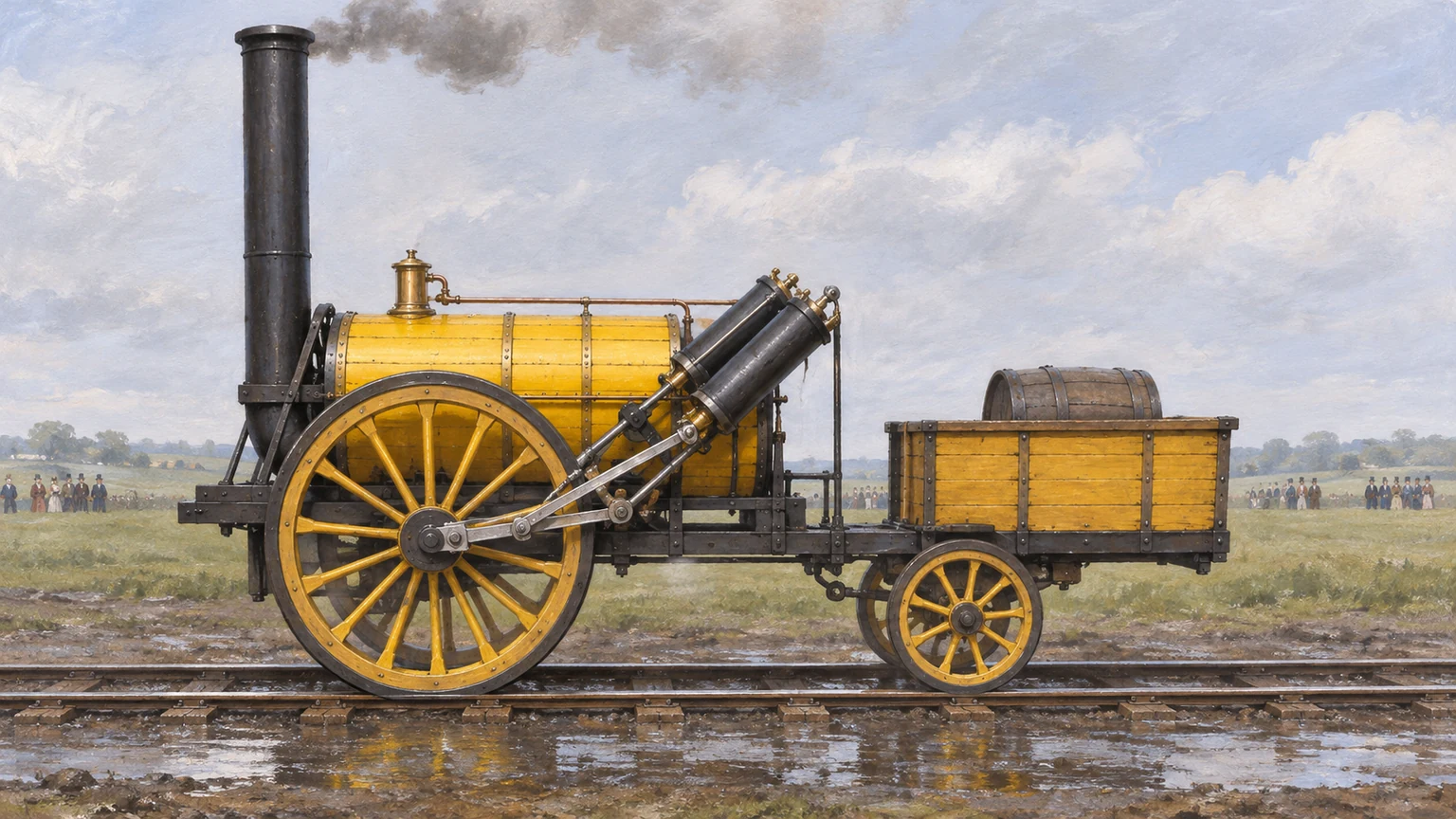
On October 8, 1829, Stephenson’s Rocket completed its successful test at the Rainhill Trials. It ultimately won the competition, which put speed, reliability, and engineering to work making the case for steam.
8
events in todayish file
1829
Stephenson’s Rocket completes its successful test at the Rainhill Trials.
A public engineering competition helped settle how the Liverpool and Manchester Railway would move — and what a locomotive could prove under pressure.
The Rainhill Trials were practical theater. The Liverpool and Manchester Railway needed motive power, engineers brought competing designs, and spectators watched machinery face the discipline of repeated runs. A locomotive had to do more than look ingenious; it had to keep moving.
Rocket, built by George and Robert Stephenson, combined features into a machine that proved fast and reliable enough to win. Its victory did not invent the steam locomotive in a single afternoon, but it made a persuasive public demonstration of the form’s potential.
Railways would compress travel time, reorganize trade, alter landscapes, and impose a new rhythm on daily life. October 8 keeps the smaller scene at the threshold: a track, a trial, and a machine demonstrating what reliable steam power could do.
The full record
8 entries from the day’s archive, filed year by year with a note on what each one leaves behind.
Contemporary reports put Hurricane Matthew’s death toll in Haiti near 900.
Communities, especially in Haiti, faced the storm’s immediate destruction and a long recovery from lost homes and infrastructure.
Disaster
Thomas Eric Duncan, the first person diagnosed with Ebola in the United States, dies.
His illness brought the West African epidemic into direct contact with the American health system and public attention.
Health
The magnitude 7.6 Kashmir earthquake kills tens of thousands, injures many more, and leaves about 2.8 million people homeless.
The disaster devastated mountain communities across Pakistan-administered Kashmir and neighboring regions as winter approached.
Disaster
U.S. President George W. Bush establishes the Office of Homeland Security by executive order.
The new office coordinated domestic-security policy in the aftermath of the September 11 attacks.
Government
Aleksandr Solzhenitsyn wins the Nobel Prize in Literature.
The award recognized writing that confronted repression and preserved testimony about the Soviet system.
Literature
Der Spiegel publishes an article on the condition of the Bundeswehr, setting off accusations of treason.
The resulting affair became a major test of press freedom and state power in West Germany.
Media
Stephenson’s Rocket completes its successful test at the Rainhill Trials.
Rocket ultimately won the competition, helping establish the steam locomotive as practical machinery for a new railway age.
Technology
Jeanne Mance opens Hôtel-Dieu de Montréal, one of North America's earliest hospitals.
The institution joined medical care to the building of the young settlement that would become Montreal.
Health