Holiday feature · Culture
A cloth that keeps its memory
Indonesia’s Batik Day honors a textile tradition written in wax, dye, repetition, and practiced hands. Every finished cloth carries more than a pattern: it bears the traces of making, place, and use.
Observed
October 2
Batik Day brings an Indonesian textile tradition into schools, workplaces, ceremonies, and ordinary public life.
Making method
Wax and dye
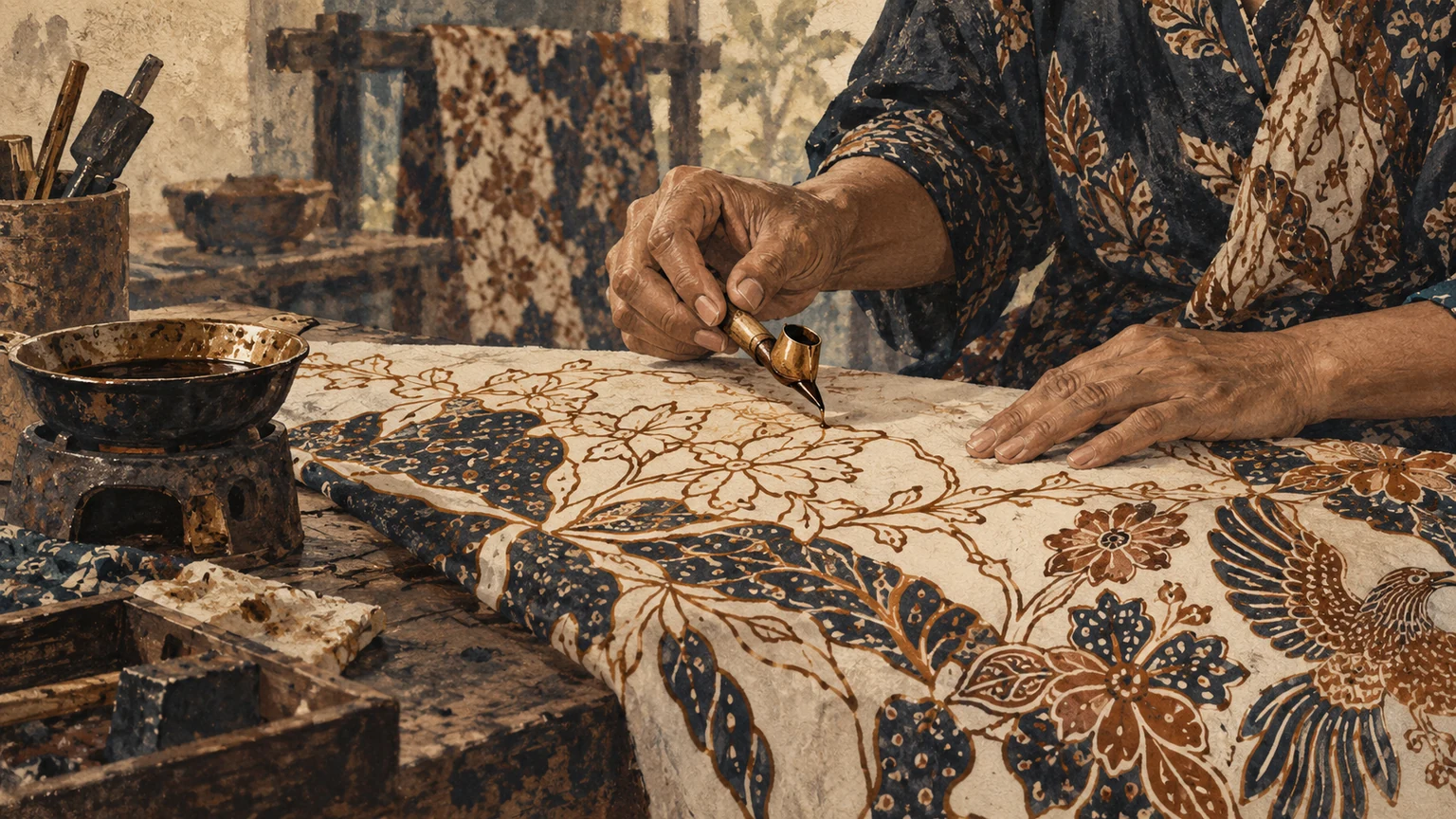
Wax resists the dye, allowing makers to compose patterns through successive decisions about what cloth will take color.
What travels
Pattern and place
Motifs, colors, and uses vary, giving batik a vocabulary broad enough to carry local identity and personal occasion.
Public form
A tradition worn
The cloth belongs not only to collections and workshops but to daily dress, formal gatherings, and family milestones.
The design begins with what stays pale
Batik is made by deciding where color will not go. Wax laid onto cloth protects selected lines and shapes from the dye bath; when the wax is removed, the reserved pattern appears. More colors can mean more rounds of covering, dyeing, and revealing.
The result records a sequence of choices. A border, flower, field of geometry, or curling line is not merely printed on the surface; it emerges from patient layers of protection and change.
A wardrobe of belonging
No single pattern can stand for all Indonesian batik. Designs and palettes differ across regions and workshops, shaped by local histories, materials, exchange, and the occasions for which a cloth is made.
That variety gives batik its civic breadth. It can mark ceremony or workday, inheritance or experiment. Worn in public, the textile turns cultural memory into something visible, useful, and continually renewed.
Knowledge held in the hand
A finished length of cloth can be displayed in an instant; the judgment behind it takes longer to acquire. Heat, wax, pressure, spacing, and color all ask for a maker’s attention, and skill passes through demonstration as much as description.
Batik Day celebrates that chain of knowledge. The garment may be the most visible part, but beneath it lies the workshop rhythm: draw, cover, dye, dry, and begin again.
More from October 2
Full edition
On this day
The journalist who did not return
In 2018, Washington Post journalist Jamal Khashoggi was assassinated in the Saudi consulate in Istanbul.
Full edition
Everything else on October 2
Open the rest of October 2: textile traditions, public records, birthdays, supper, and games.
Calendar
Continue through October
Follow the month through changing light, civic observances, cultural traditions, and the long approach to Halloween.