Holiday feature · Faith & tradition
The feast gathered around a flame
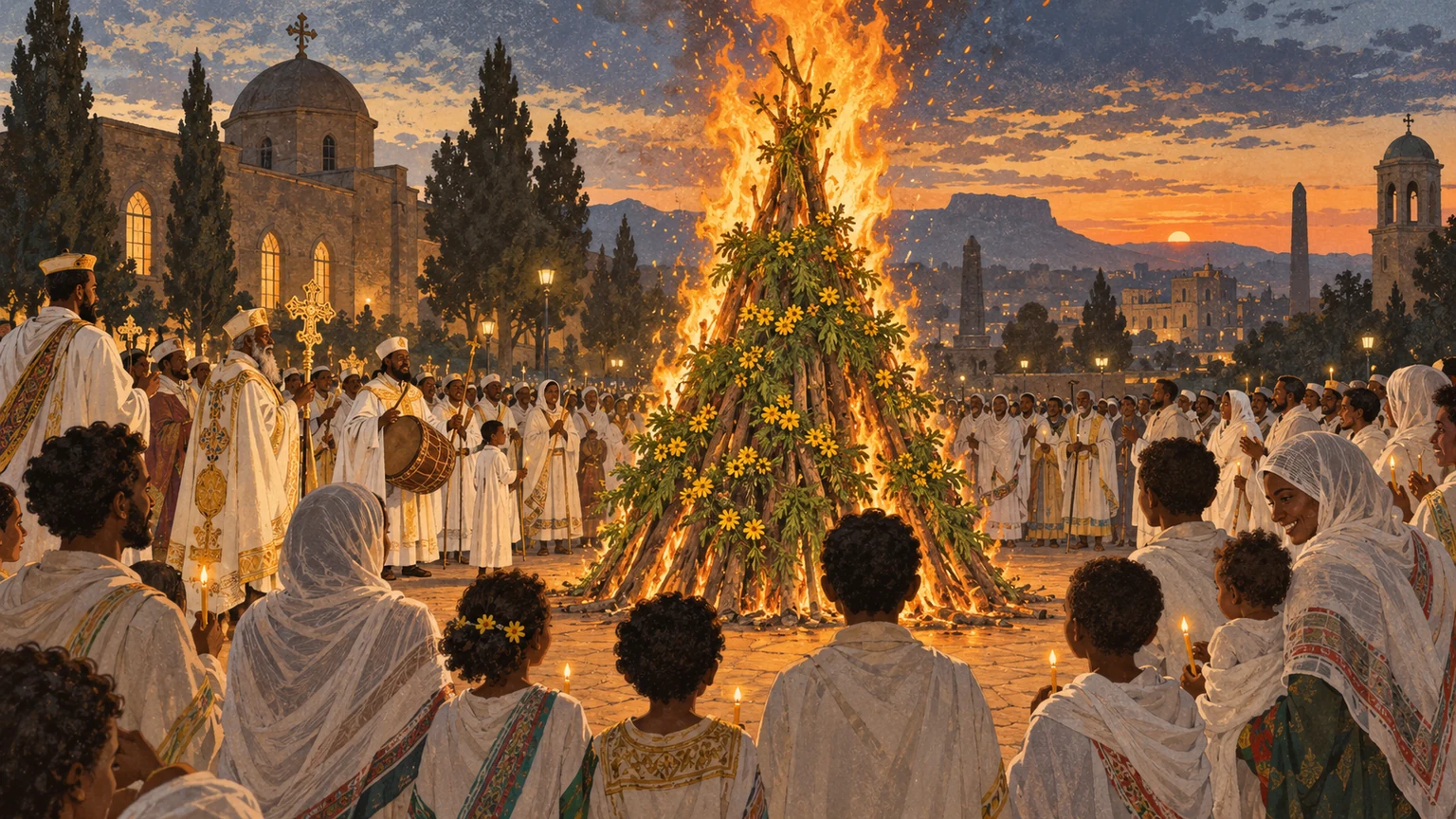
Meskel commemorates the finding of the True Cross in the Ethiopian and Eritrean Orthodox tradition. Prayer, procession, flowers, and fire give the feast its public shape, bringing an ancient Christian story into the company of families and communities.
Observed
September 27
The feast falls a day later in leap years under the calendar tradition named in the observance.
Religious meaning
The finding of the True Cross
Meskel commemorates the Christian tradition of Saint Helena’s discovery of the cross on which Jesus was crucified.
Ritual center
The Demera bonfire
In Ethiopia, communities build and light a ceremonial pyre as hymns, prayers, and procession gather around it.
Seasonal color
Green grass and yellow daisies
Fresh greenery and bright flowers place the feast within the Ethiopian New Year season.
A story told in fire
Meskel remembers a search and a sign. In Orthodox Christian tradition, Saint Helena sought the cross on which Jesus had been crucified, and smoke from a fire revealed where it lay. The feast carries that account forward through worship and the public lighting of a bonfire.
Fire gives the commemoration a language that can be seen across a square. It turns a story of discovery into a shared act, surrounded by hymns, prayers, clergy, families, and the expectation built through preparation.
The square becomes a sanctuary
In Ethiopia, the Demera is built as a tall ceremonial pyre, dressed with green grass and yellow Abyssinian daisies. At major gatherings and in local communities, worship moves outdoors, and the crowd becomes part of the feast’s visible form.
The largest flame may command the eye, but Meskel is sustained at a human scale. Churches coordinate celebrations, relatives return home, neighbors gather, and a religious observance also becomes a season of reunion.
What remains after the flame
A bonfire rises, burns, and settles into ash. The feast lasts because its meaning is carried elsewhere: into liturgy, family memory, reconciliation, and the repeated work of preparing to gather again.
Meskel joins Ethiopian and Eritrean Orthodox Christians in a tradition at once ancient and present. Each year, the flame is made anew — not to recover the past unchanged, but to keep faith, story, and community in one another’s light.
More from September 27
Full edition
On this day
The book that asked where the birds had gone
In 1962, Rachel Carson published Silent Spring, bringing the ecological costs of indiscriminate pesticide use into public view.
Full edition
Everything else on September 27
Return to the complete Gazette for national observances, history, birthdays, supper, and games.
Calendar
Finish September
Follow the month through its closing days, where national anniversaries, feast days, and autumn history share the calendar.