On this day · archive
The night the deep ocean answered
An American-French expedition located Titanic on the North Atlantic seabed in 1985. The discovery did not lift the ship from the deep; it gave a famous loss a physical outline and a place on the ocean floor.
8
events in todayish file
1985
An American-French expedition led by Robert Ballard and Jean-Louis Michel discovers the wreck of Titanic.
The ship had long lived in testimony and imagination. Then the ocean floor returned a physical outline, scattered and unmistakable.
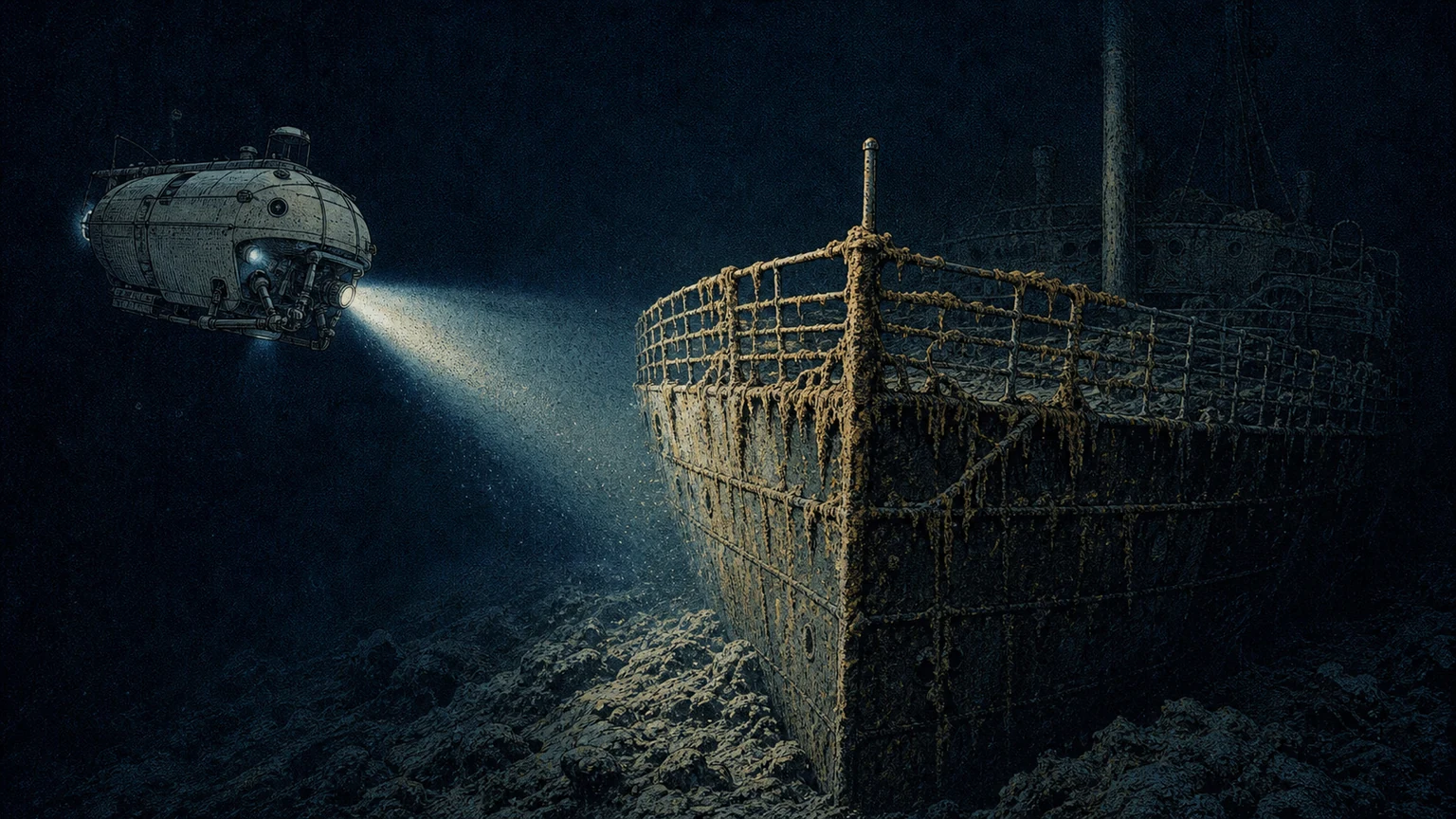
For decades, Titanic existed in two forms: the ship remembered by survivors and the ship imagined beneath the North Atlantic. On September 1, 1985, an American-French expedition led by Robert Ballard and Jean-Louis Michel found the wreck.
Deep-sea discovery is an encounter by instruments and narrow beams. Darkness yields details a little at a time, and a famous name resolves into metal, distance, and a site whose condition tells its own story.
Finding the wreck did not close the disaster. It changed the terms of remembrance, joining testimony to physical evidence and giving the public a place — remote, fragile, and exact — for a story that had drifted through culture for generations.
The full record
8 entries from the day’s archive, filed year by year with a note on what each one leaves behind.
Iraq War: The United States Armed Forces transfers control of Anbar Province to the Iraqi Armed Forces.
Control of Anbar Province passes to Iraqi forces, changing responsibility within an unfinished war.
War
The wreck of the Titanic is discovered by an American-French expedition led by Robert Ballard and Jean-Louis Michel.
The wreck’s location gives a famous maritime disaster a physical site and a new field of study.
Discovery
Cold War: Korean Air Lines Flight 007 is shot down by a Soviet jet fighter after the commercial aircraft strayed into Soviet airspace, killing all 269 on board, including Congressman Lawrence McDonald.
The destruction of Flight 007 kills 269 people and sharpens Cold War danger around a civilian aircraft.
War
The United States Air Force Space Command is founded.
A new Air Force command formalizes the military importance of operations beyond the atmosphere.
Military
Central African President David Dacko is ousted from power in a bloodless military coup led by General André Kolingba.
A bloodless coup removes Central African President David Dacko from office.
Politics
J. Robert Oppenheimer and his student Hartland Snyder publish the Oppenheimer–Snyder model, proving for the first time in contemporary physics how black holes could develop.
The Oppenheimer–Snyder model gives modern physics a path for understanding gravitational collapse.
Science
The Tremont Street Subway in Boston opens, becoming the first underground rapid transit system in North America.
Boston’s subway opening begins underground rapid transit in North America.
Transit
Emma Nutt becomes the world's first female telephone operator when she is recruited by Alexander Graham Bell to the Boston Telephone Dispatch Company.
Emma Nutt’s hiring opens a new occupation to women, even within the era’s narrow labor rules.
Work