On this day · archive
The punched cards that counted the modern world
June 8 keeps violence, storms, space hardware, nuclear policy, literature, cabinet history, and an early data-machine patent in its archive. Herman Hollerith’s punched-card filing gives the date a quiet hinge between paperwork and computation.
8
events in todayish file
1887
Herman Hollerith applies for a U.S. patent for the 'Art of Compiling Statistics,' his punched-card calculator.
The entry sounds clerical, almost dusty. Inside it is a machine-age answer to a modern problem: how to make a flood of records countable.
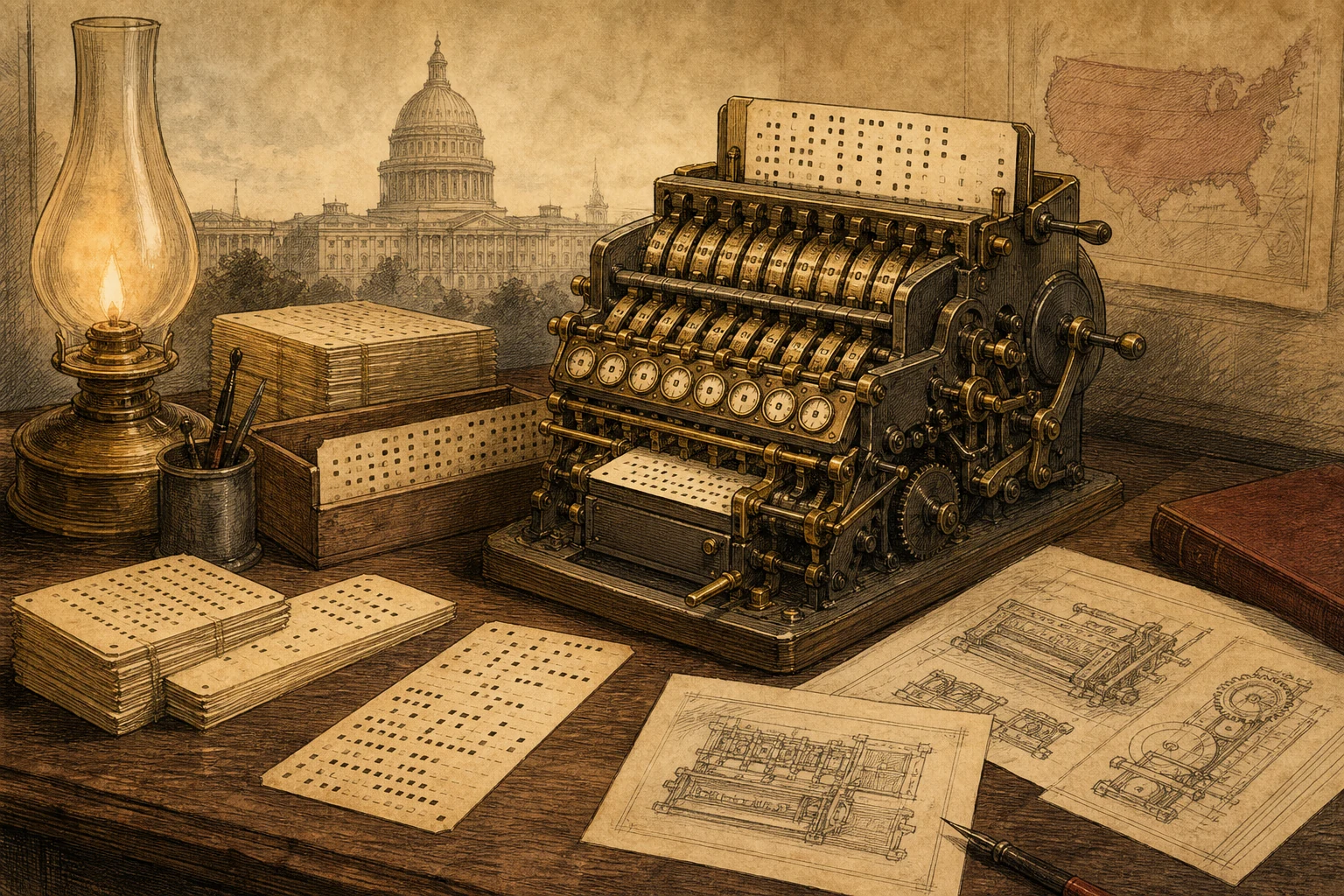
The archive records a patent application, but the object behind it is larger than office paperwork. Herman Hollerith applied for U.S. patent #395,781 for the 'Art of Compiling Statistics,' a punched-card calculator built to make information move through machinery.
It is a modest-looking kind of history: holes in cards, sorted and counted. Yet the idea carries the force of a new administrative age, where populations, businesses, and governments were producing more records than hands could easily master.
Around it, June 8 includes storms, violence, spaceflight, nuclear policy, literature, and cabinet history. Hollerith’s entry gives the date a quieter instrument: the beginning of data becoming a machine-readable public fact.
The full record
8 entries from the day’s archive, filed year by year with a note on what each one leaves behind.
Seven people are killed and 11 more are injured in a massacre in Akihabara.
The date carries a city tragedy remembered through an ordinary district suddenly marked by public violence.
Violence
Newcastle, New South Wales, is hit by the state’s worst storms and flooding in 30 years, killing nine people and grounding the MV Pasha Bulker.
The storm leaves both a human toll and a stranded ship, giving the disaster a coastline image that lingered in public memory.
Disaster
Space Shuttle Atlantis launches on STS-117 with truss segments and solar arrays for the International Space Station.
The date’s second 2007 entry looks upward, adding construction work in orbit to the same day’s storm-bound record below.
Space
Mamoru Takuma kills eight and injures 15 in a mass stabbing at an elementary school in Osaka Prefecture, Japan.
The archive turns toward grief and the vulnerability of a school day broken by violence.
Violence
New Zealand’s Labour government establishes a national nuclear-free zone under the New Zealand Nuclear Free Zone, Disarmament, and Arms Control Act 1987.
A national policy turns anti-nuclear identity into statute, giving the date a durable civic boundary.
Civic
George Orwell’s dystopian novel Nineteen Eighty-Four is published in the United States.
A literary warning enters another readership, carrying surveillance, language, and power into the date’s cultural ledger.
Literature
Margaret Bondfield is appointed Minister of Labour, becoming the first woman appointed to the Cabinet of the United Kingdom.
The appointment gives the day a civic first, recorded through a name, an office, and a door opened in government.
Civic
Herman Hollerith applies for U.S. patent #395,781 for the 'Art of Compiling Statistics,' his punched-card calculator.
The patent points toward data processing before the phrase sounds familiar: paper cards becoming instructions a machine can count.
Technology