Holiday feature · Tradition
When the mountains carry the farewell
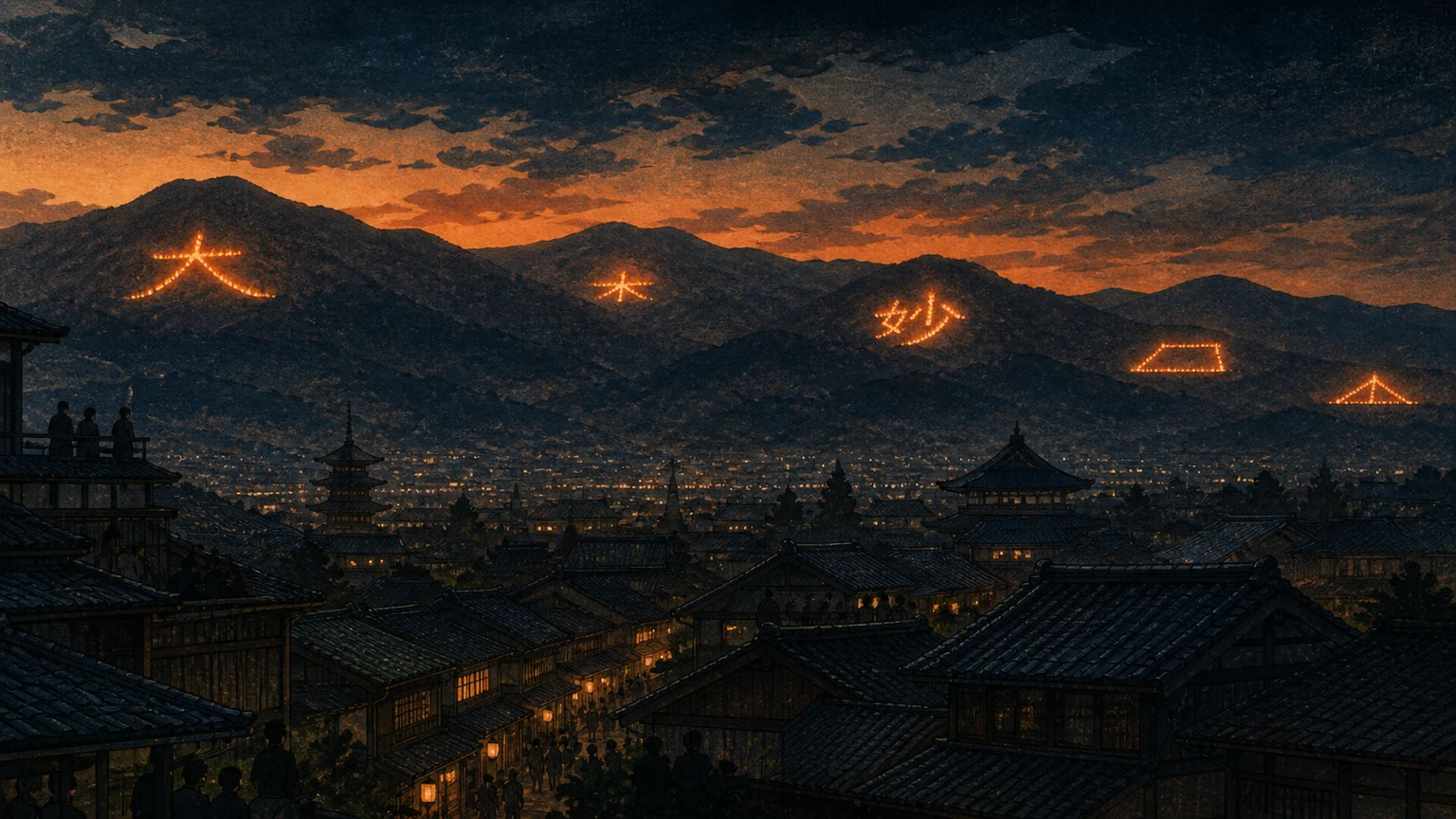
On the final evening of Obon, Kyoto’s Gozan no Okuribi lights five mountainside bonfires to symbolically see ancestral spirits on their way. Across the city, farewell is written in fire at a distance.
Observed
August 16
The observance belongs to Kyoto’s late-summer calendar.
Public hour
After dusk
Five mountainside fires become a shared line of sight across Kyoto.
Ritual place
The close of Obon
The bonfires mark a symbolic farewell to ancestral spirits at the festival’s end.
Calendar company
Battles, restoration, childhood
August 16 also carries civic anniversaries and remembrance across several countries.
Five fires on the horizon
Gozan no Okuribi asks Kyoto to read its horizon. On five mountains, bonfires appear in sequence as Obon reaches its close and the city turns toward a shared farewell.
The scale is unusual: intimate meaning carried at civic distance. The fires are far away, yet whole neighborhoods can look toward them at once.
The farewell at Obon’s end
Obon welcomes the memory of ancestors into the household and community. On its final evening, the mountain fires symbolically guide those spirits on their departure.
The ritual gives leave-taking a visible form without pretending to hold it still. Flame makes the goodbye legible; distance gives it room.
What remains after the glow
Ceremonial fire is brief by design. The light arrives, holds the eye, then thins back into darkness.
That brevity gives the observance its discipline. Kyoto keeps the evening not by preserving the flame, but by returning to the same five mountains each year.
More from August 16
Full edition
On this day
Sport enters the weekly press
The first issue of Sports Illustrated appeared in 1954, treating games, athletes, and outdoor life as material for sustained national journalism.
Full edition
Everything else on August 16
Return for Kyoto’s companion observances, birthdays, food, games, and the rest of the day.
Calendar
Browse August
Continue through August’s ceremonies, civic anniversaries, and late-summer turns.